P.A.R. is a flip-squisk display that draws your pixel art
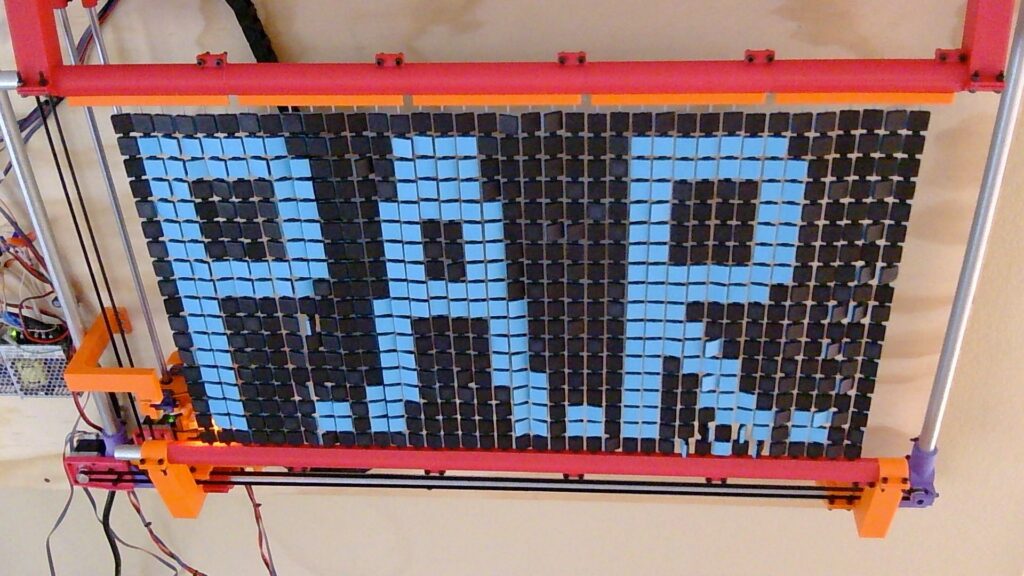
Flip-disc displays used to be very common in the days before affordable LEDs, LCDs, and OLEDs. But as electromechanical devices with a lot of moving parts, they’re expensive and rare today. That’s a shame, because they’re charming. That charm is what led Zimm to the creation of this novel flip-squisk display called P.A.R (Pixel Art Robot) that accepts art from the community.
A “squisk” is a square disc, with one light-colored side and one dark-colored side. Zimm made his squisks by 3D printing the two sides with interlocking channels, so they come together and form one unit. The display is a 37 × 18 grid of those. By flipping them between light and dark sides, it can create a low-resolution raster monochrome image.
Other than using squares instead of circles, that is pretty much the same concept as a normal flip-disc display. But P.A.R. actually works in a very different way, and the “robot” part of the name hints at that.
A normal flip-disc display uses a solenoid to manipulate a permanent magnet on the axle of the disc, flipping it one way or the other. That requires a solenoid (and control over that solenoid) for every single disc, which results in a massive bill of materials and the high cost.
Zimm’s P.A.R. doesn’t do any of that. Instead, there is a robot behind the display that reaches over to each squisk and physically flips it. There are no solenoids or magnets. That robot is kind of like a pen plotter turned up vertically, with a servo-actuated pin that pushes squisks around. That operates under the control of an Arduino® Nano™ ESP32 board, which also has a color sensor to detect the current state of the squisk in front of it.
The advantage of this design is the elimination of the solenoids. Zimm could scale up the size and resolution of the display by simple extending the axes and adding squisks. The disadvantage is that it is very slow compared to a traditional flip-disc display.
And because P.A.R. has a Nano ESP32, it can connect to the internet. Zimm set up a website where visitors can submit art, which P.A.R. will then “draw” onto the display where everyone can see it. The website contains a gallery of all of the drawn images. Take a look at those or submit your own art!