Beyond Edge AI: bringing local intelligence to Arduino UNO Q
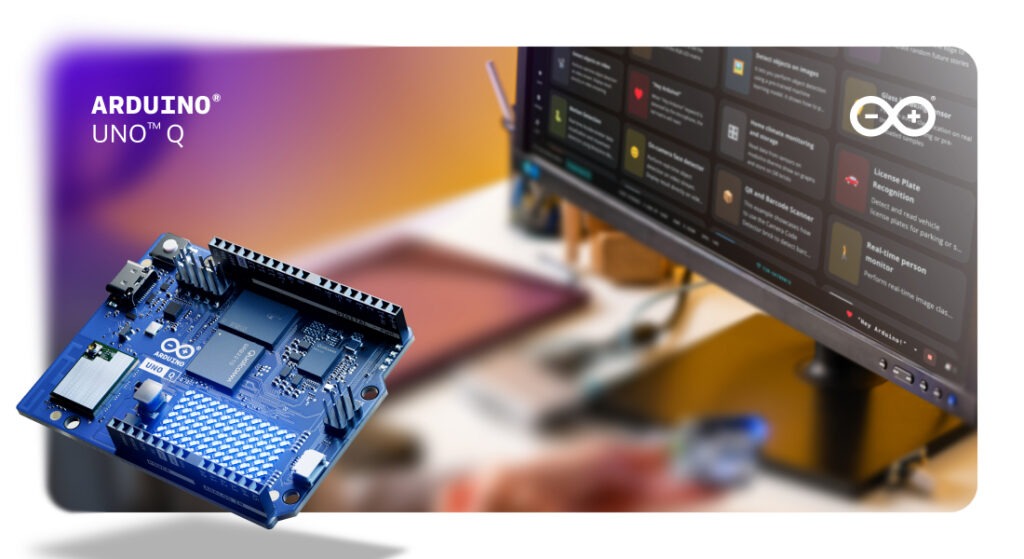
Edge AI is evolving quickly. It was the end of 2022 when the world saw the first Cloud AI tool available to everyone, accessible through a simple and intuitive chat. In less than four years, models have been refined, distilled, optimized, quantized – at record-breaking speed – to meet the needs of the first generation of edge systems focused mostly on detection and classification: identifying an object, recognizing a keyword, or triggering an action when a predefined event occurs.
The landscape is changing so quickly that the conversation is now already shifting toward something more interesting. Devices are starting to move from simple recognition to local understanding.
So instead of asking, “What is this?”‘ developers are beginning to ask:
- “What is happening here?”
- “What does this information mean?”
- “What action should the system take next?”
This is where local AI agents, LLMs, and intelligent workflows start becoming relevant at the edge.
That does not mean every device suddenly needs to run massive cloud-scale models. In most real-world scenarios, the goal is not running the biggest possible AI model – but running the right intelligence close to where data is generated. This is exactly the space where the Arduino® UNO™ Q board shows its full potential.
By combining Debian Linux with a real-time STM32 microcontroller, UNO Q creates a hybrid platform where developers can experiment with practical local intelligence while still interacting reliably with sensors, actuators, cameras, industrial signals, and physical systems.
The Linux side can manage higher-level orchestration, local AI frameworks, APIs, dashboards, and model execution. The microcontroller side continues handling deterministic I/O, timing-sensitive interactions, and hardware control. That balance makes it possible to explore a new category of edge applications that don’t immediately depend on cloud infrastructure.
Now, let’s briefly explore three major directions in which UNO Q is contributing to reshaping edge computing. This is the introduction to a series of posts, where we’ll dive into each of these topics in more detail.
Building local AI agents on UNO Q
With the latest developments of agentic AI making headlines in the tech-world news, the next step is creating systems capable of reasoning about tasks and coordinating actions locally.
AI agents are essentially workflows where models interact with tools, hardware, APIs, sensors, or software services to complete specific objectives. On UNO Q, this means creating systems that observe the environment, interpret context, and trigger actions directly on the device.
For example, David Groom ran OpenClaw on UNO Q to access embedded hardware conversationally, with a zero code approach – but an agent could also query and analyze information coming from sensors, summarize machine conditions, read visual states from a camera, or interact with connected services while still keeping the execution flow local. The interesting part is creating focused systems that are useful, understandable, and deployable in real products.
Because UNO Q combines Linux with real-time hardware control, these agents can move beyond chat interfaces and directly interact with the physical world. Interested in finding out more? Stay tuned for the dedicated article in this series.
Start experimenting with radical accessibility, following David’s example here.
Running local LLMs on UNO Q
Local language models are opening the door to a different type of edge interaction.
Instead of sending every request to the cloud, developers can run compact models directly on the device for task-specific workflows such as local assistants, OCR (optical character recognition), status summarization, command parsing, or contextual responses.
There are huge advantages to this in terms of privacy, any time keeping sensitive operational data on-device matters. But the real game-changer in this type of application is the reduced dependency on connectivity paired with improved responsiveness, resulting in systems that continue to operate without skipping a beat even when the network is unavailable.
UNO Q provides a practical platform for these experiments thanks to its Debian Linux environment, support for local AI frameworks, and compatibility with optimized inference workflows. Check out the documentation on this Project Hub entry by Robuinlabs to build your own private AI assistant, creating a local LLM chatbot that can run even when the internet is down or connection is not available.
There are, of course, constraints to what models can realistically run on the board, and on the computational power that can be expected from the nimble and cost-effective UNO Q. However, the trade-off may often prove perfectly acceptable for many experiments, prototypes, and a wide range of light applications. You don’t need a sledgehammer to crack a nut!
We’ll dive deeper into all of this in the next blog post in this series.
Build your own AI assistant with a local LLM chatbot, thanks to Robuinlab’s tutorial here.
Automating AI workflows on UNO Q
The final step goes beyond single models or isolated agents.
Modern AI systems increasingly rely on workflows composed of multiple stages: capturing information, analyzing context, generating responses, triggering actions, and coordinating software execution. This includes workflows like local audio transcription and object recognition pipelines, multi-source data acquisition and automation systems: a great example of how all of this can fit together is Kevin McAleer’s “Nibsy” project, an AI agent that watches you work, listens to what you say, and at the end of a session writes the tutorial for you.
In these scenarios, the AI model becomes part of a larger orchestration pipeline rather than a standalone feature.
Using UNO Q is particularly interesting here because it allows developers to combine multiple layers together: Linux applications, Python environments, AI frameworks, cloud-connected services, local APIs, and deterministic microcontroller logic – all running side by side. Some workflows may use local models entirely on-device. Others may combine local execution with cloud-based reasoning depending on latency, privacy, or computational requirements.
The important shift is that UNO Q is no longer limited to simple inference. It enables solutions that coordinate complex operational workflows while remaining closely connected to the physical environment. We’ll see a few inspiring examples of how this can happen in a dedicated blog post.
Explore how AI can automate complex projects in the example documented by Kevin here.
From AI demos to useful edge systems
One of the biggest misconceptions around AI at the edge is that success is measured by running the largest possible model. In reality, most successful deployments are built around smaller, focused systems designed for specific operational goals – such as:
- Reading text locally from a camera feed
- Recognizing gestures without streaming video to the cloud
- Summarizing machine states
- Interpreting operator commands
- Triggering actions from simple contextual understanding
- And many other practical examples of intelligence creating real value directly on-device!
UNO Q makes experimenting and building applications approachable by combining familiar Linux development with the flexibility of the Arduino ecosystem and real-time hardware interaction. All of it is built leveraging Arduino® App Lab and the Bricks available there.
Over the next three articles in this series, we’ll explore how local AI agents, LLMs, and complex AI workflows can move from experimentation into practical edge applications running on UNO Q. Are you ready to explore with us?
Arduino, and UNO, and the Arduino logo are trademarks or registered trademarks of Arduino S.r.l.