WireDrum forces your muscles to learn skills
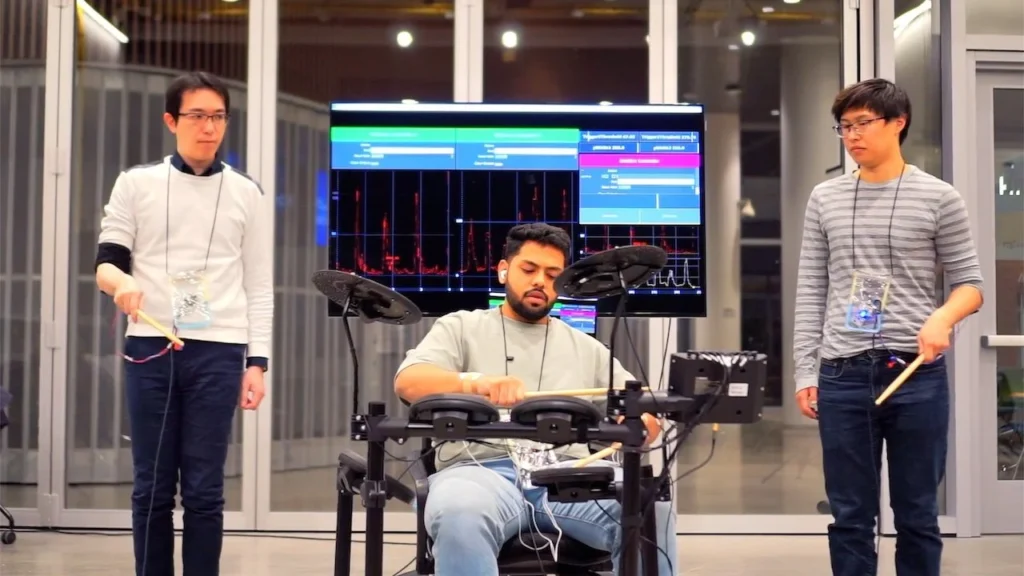
In a movie full of cool stuff, the most compelling fantasy in The Matrix is the ability to download and instantly learn skills. When skills take hundreds or even many thousands of hours to develop in the real world, that kind of on-demand skill access would be incredible. Designed by researchers at the University of Maryland’s Embodied Dynamics Laboratory and the Nagoya Institute of Technology, WireDrum is intriguing new tech that provides a feasible means to “program” our bodies with new skills in a similar way.
WireDrum can’t beam skills directly into your brain, but it may be the next best thing. It stimulates the user’s muscles, forcing them to perform the desired action. When playing drums, which is the primary use case demonstrated in the paper, the system can make the user pound out beats, even if they’ve never touched drum sticks before. Ideally, that would create muscle memory over time and give the user the ability to play unassisted — though such capability wasn’t tested by WireDrum’s creators.
To work, the system needs to “record” the muscle activity of an experienced drummer and then “play” that recording through the target user’s muscles. WireDrum does the former with a custom two-channel EMG (electromyography) device called bioSense. It then does the latter with an EMS (electrical muscle stimulation) device called bioStim, built around an Arduino Nano ESP32 board. The bioStim device provides electrical stimulation through a DC-DC converter putting out 35V to electrodes placed on the user’s arms.
While drumming may be inconsequential in the grand scheme of things, similar methods could be used for more practical skills.