WaterLens uses AI on the edge to detect water quality issues
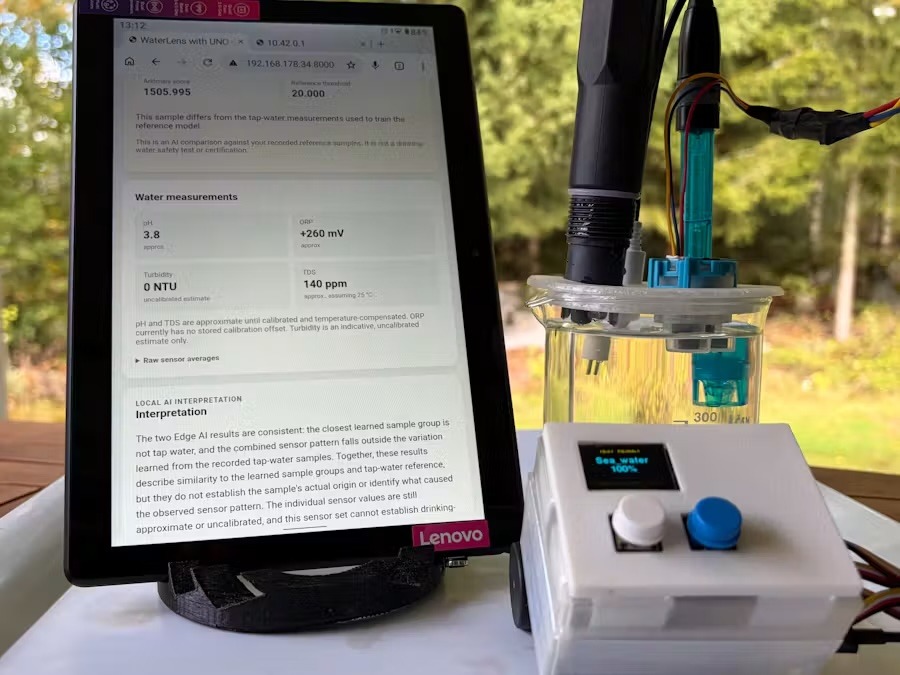
According to a 2025 report from the WHO and UNICEF, approximately an entire quarter of the world’s population currently lacks consistent access to safely managed drinking water. The report also states that many people without safely managed drinking water had access to basic drinking water services. Thomas Vikström developed WaterLens as a tool intended to help users assess certain water quality indicators.
WaterLens is a compact device designed to give communities an affordable ability to monitor their local water sources. It is not a substitute for comprehensive laboratory testing and should not be used by itself to determine whether water is safe to drink. The device is designed to provide supplemental information when laboratory testing is not readily available. Its creator also designed it to be constructed and operated without advanced technical skills.
A WaterLens device can be assembled using off-the-shelf components that connect without soldering. Those components include an Arduino® UNO™ Q board, a Seeed Studio Grove Base Shield, a Grove OLED screen, a Grove dual-button module, and a host of Grove sensors. Those sensors are designed to measure pH, turbidity, total dissolved solids (TDS), and oxidation-reduction potential (ORP).
Displaying measurements from each sensor may be useful, but interpreting those measurements may require relevant water quality expertise. WaterLens runs a local model, trained and deployed with Edge Impulse, that is designed to identify potential anomalies in the sensor data.
WaterLens may help identify sensor readings that warrant further investigation. A sample with no detected anomalies should not be assumed to be safe to drink, and a detected anomaly does not by itself establish that the water is unsafe. WaterLens cannot and should not replace validated water quality testing. Where laboratory testing is not readily available, the device may provide supplemental information that can help users decide whether further evaluation is appropriate.
Arduino and UNO are trademarks or registered trademarks of Arduino S.r.l.