Digitize analog gauge readings with edge AI
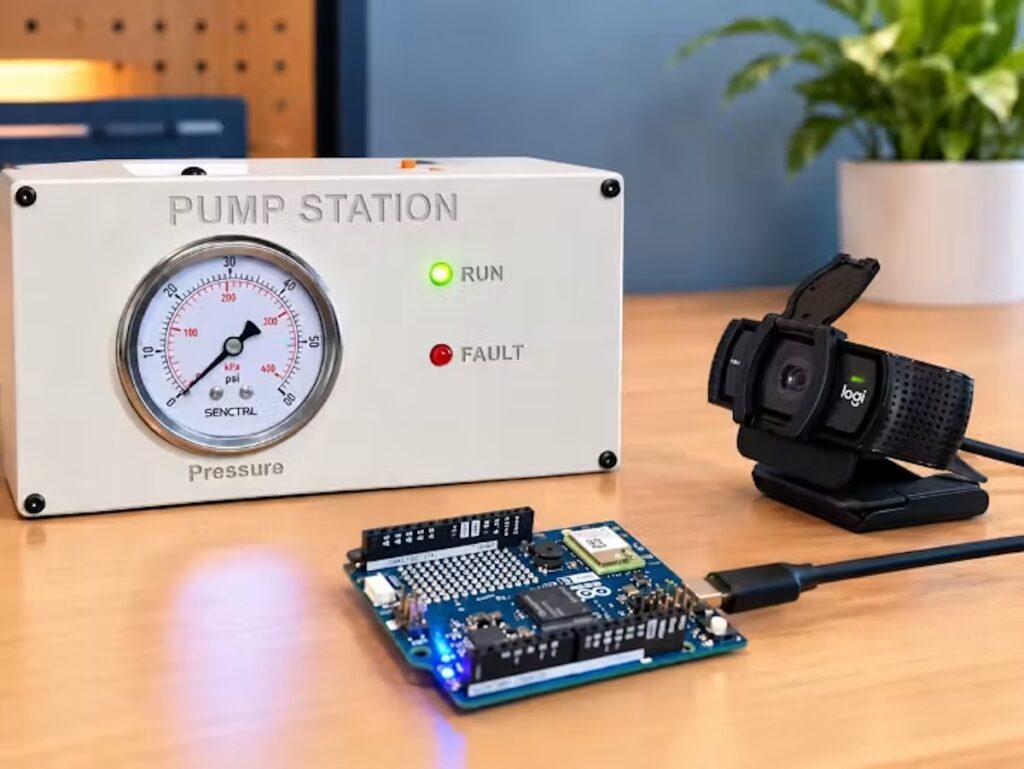
Expense calculations in the industrial world tend to be unintuitive to individuals, because service and maintenance often consume larger chunks of the budget than the equipment itself. For that reason, modifications to equipment are usually seen as too risky to justify — they can too easily impact serviceability. So, what do you do when you want to bring an old piece of equipment into the modern age? Michael Bryan Ross’ solution was to use AI to look at analog gauges.
Ross wanted to address a simple and common problem: the equipment has an analog gauge and it would be nice to have that value available in digital form for monitoring and logging.
Most of us, when presented with that problem, would take the easy and seemingly reasonable approach. That might be something like replacing the analog gauge with a microcontroller outfitted with an ADC (analog-to-digital converter).
But very few plant managers or manufacturing engineers are going to give the green light on a modification like that. Not only is there upfront downtime to consider, but it also puts the equipment and future serviceability at risk.
Ross’ solution, on the other hand, is much easier to approve. That’s because it doesn’t require any modification to the equipment at all. In fact, it doesn’t even need to make physical contact with the equipment.
It works by using a camera and AI running on the edge to read the analog gauge. In this case, “the edge” is an inexpensive Arduino® UNO™ Q and it looks at the gauge through a standard USB webcam. The UNO Q runs a MobileNetV3-Small model through ONNX Runtime.
To test that — and to gather the images needed to train the model in the first place — Ross built a physical device with a real analog gauge driven by an actual pressure sensor. To create a training data set, Ross simply collected a bunch of images of the gauge’s needle in different position, then had GPT-5.6 read the black ticks to classify them by numeric value.
Ross acknowledges that the resulting model isn’t perfect. In particular, it tends to lose accuracy at very high and very low ends of the gauge range. But that is a fixable problem (largely through training). The concept holds: that this approach makes it possible digitize analog gauges, without spending much money and without modifying equipment.